
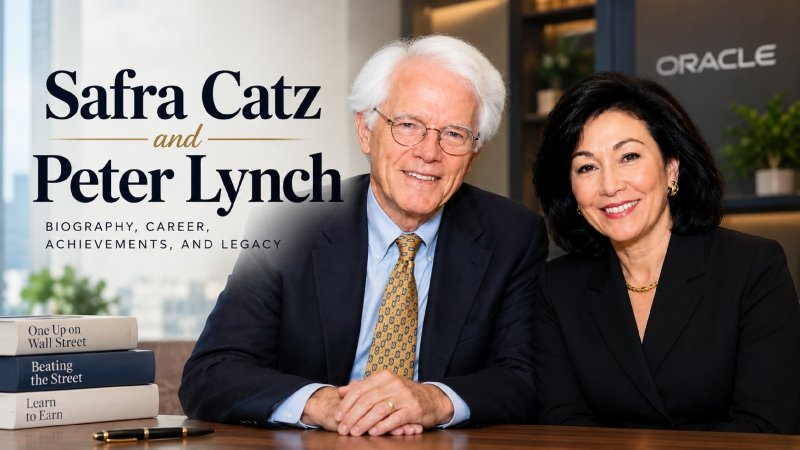
Safra Catz and Peter Lynch built two very different careers, but both became influential figures in their respective fields. Catz developed a long career in investment banking, corporate finance, technology, and executive leadership, eventually becoming one of the most recognizable leaders at Oracle. Lynch, meanwhile, became famous for his research-driven approach to investing and his thirteen-year management of Fidelity’s Magellan Fund.
They did not work together, and there is no documented professional connection between them. However, looking at their careers side by side provides an interesting comparison of leadership, research, financial decision-making, long-term thinking, and professional discipline.
Quick Facts About Safra Catz and Peter Lynch
| Category | Safra Catz | Peter Lynch |
| Main field | Technology and corporate leadership | Investing and portfolio management |
| Best known for | Oracle leadership and corporate strategy | Managing Fidelity Magellan Fund |
| Major organization | Oracle | Fidelity Investments |
| Education | University of Pennsylvania | Boston College and Wharton |
| Career strength | Finance, M&A, technology leadership | Investment research and portfolio management |
| Major legacy | Oracle’s growth and strategic transformation | Investment education and philanthropy |
Who Is Safra Catz?
Safra A. Catz is an Israeli-American business executive best known for her long career at Oracle. She joined the company in 1999 and went on to hold several senior positions, including president, chief financial officer, executive vice president, and chief executive officer.
Catz served as Oracle’s CEO from 2014 until September 2025. She now serves as Executive Vice Chair of Oracle’s Board of Directors. Oracle’s current executive biography also notes her work as a lecturer at Stanford Graduate School of Business and her involvement with the Oracle Education Foundation and other boards.
Her career is notable because it combines financial expertise with technology leadership. Before Oracle, she worked in investment banking, where she developed experience in corporate finance and mergers and acquisitions.
Safra Catz Early Life and Education
Safra Catz was born in December 1961 in Holon, Israel. Her family later moved to the United States, where she continued her education and professional development.
She attended the University of Pennsylvania, where she earned both a bachelor’s degree and a law degree. This combination of business-related education and legal training provided a useful foundation for a career involving corporate finance, negotiations, acquisitions, and executive decision-making.
Her educational background later became especially relevant as she took on increasingly important roles at Oracle.
Safra Catz’s Career Journey
Investment Banking Years
Before joining Oracle, Catz worked at Donaldson, Lufkin & Jenrette, an investment bank. She eventually became a Managing Director in Investment Banking.
This experience gave her exposure to corporate finance and complex transactions. Her background in investment banking became particularly valuable when she later became involved in Oracle’s acquisition strategy.
Joining Oracle
Catz joined Oracle in 1999. She quickly moved into senior leadership positions and became a member of Oracle’s Board of Directors in 2001.
She later became co-president and chief financial officer, giving her responsibility for important financial and strategic areas of the company.
Her rise through Oracle demonstrates how financial expertise can become a foundation for broader corporate leadership.
Becoming Oracle CEO
In September 2014, Catz became co-CEO of Oracle alongside Mark Hurd. Following Hurd’s death in 2019, she continued as Oracle’s sole CEO.
She remained CEO until September 2025, when Oracle announced that Clay Magouyrk and Mike Sicilia would become co-CEOs. Catz was appointed Executive Vice Chair of the Board. Oracle said the transition would allow her to continue helping guide the company’s direction and growth.
This change is important when discussing Catz’s career today because describing her simply as Oracle’s current CEO would now be outdated.
Safra Catz and Oracle’s Acquisition Strategy
One of the most recognizable parts of Catz’s Oracle career has been her involvement in major corporate transactions.
Oracle’s expansion included significant acquisitions such as PeopleSoft, Siebel Systems, BEA Systems, and Sun Microsystems. These deals helped Oracle expand beyond its traditional database business into enterprise applications, middleware, hardware, and other areas of technology.
Catz’s investment-banking background made mergers and acquisitions a natural part of her leadership profile. Her career demonstrates how financial strategy can influence the long-term direction of a technology company.
Rather than viewing acquisitions simply as individual transactions, Oracle used them as part of a broader strategy to expand its products, customer base, and technology capabilities.
Safra Catz’s Leadership and Achievements
Catz’s achievements cover several areas:
- Long-term executive leadership at Oracle
- Senior responsibility for Oracle’s finances
- Experience in mergers and acquisitions
- Leadership during Oracle’s expansion into cloud computing
- Involvement in technology and corporate strategy
- Work in education and corporate governance
Oracle’s current biography also identifies Catz as a lecturer at Stanford Graduate School of Business. She has served as chair of the Oracle Education Foundation since 2004 and is involved with other organizations and boards.
Her career is especially interesting because she moved from investment banking into technology leadership and eventually became CEO of one of the world’s major enterprise software companies.
Who Is Peter Lynch?
Peter Lynch is an American investor, author, and philanthropist who became famous for managing Fidelity’s Magellan Fund from 1977 to 1990.
During his career at Fidelity, Lynch developed a reputation for extensive research, studying companies carefully, and looking for investment opportunities based on understandable business fundamentals.
Boston College identifies Lynch as a former portfolio manager of the Fidelity Magellan Fund and highlights his books, philanthropic work, and long relationship with the university.
Unlike Catz, whose career centered on corporate leadership and technology, Lynch became known primarily for investment research and portfolio management.
Peter Lynch Early Life and Education
Peter Lynch was born on January 19, 1944, in Newton, Massachusetts.
As a teenager, he worked as a golf caddy. The experience exposed him to conversations about stocks and business among the people he worked for.
He later attended Boston College on a caddy scholarship and earned a finance degree in 1965. He then served as a lieutenant in the U.S. Army before continuing his education at the Wharton School of the University of Pennsylvania, where he earned an MBA in 1968.
This combination of education and practical experience helped prepare Lynch for his later career in investment research.
Peter Lynch’s Investment Career
Joining Fidelity
Lynch joined Fidelity Investments in 1969. He initially worked as an analyst covering areas including textiles and metals.
His responsibilities expanded over the following years, and he eventually became Fidelity’s director of research from 1974 to 1977.
That period was important because it allowed him to study companies and industries in depth before taking responsibility for a major investment portfolio.
Managing the Magellan Fund
In 1977, Lynch became manager of Fidelity’s Magellan Fund.
Over the following thirteen years, he became one of the most closely studied fund managers in the history of active investing. Boston College notes that the Magellan Fund was the top-ranked general equity fund in the nation during his tenure.
Lynch’s career at Magellan helped make him a widely recognized figure beyond Wall Street. His ability to explain investing concepts in relatively simple language also contributed to his popularity among individual investors.
Peter Lynch’s Investment Philosophy
One of Peter Lynch’s most famous ideas is often summarized as “buy what you know.”
The idea does not mean that investors should automatically buy a company simply because they use its products. Instead, Lynch’s approach encouraged people to notice businesses and products they understood and then conduct deeper research before making an investment decision.
His approach emphasized:
- Understanding the business
- Studying company fundamentals
- Researching industries carefully
- Looking beyond short-term market movements
- Being patient with investments
- Making decisions based on evidence rather than emotion
Lynch also became associated with the use of the PEG ratio, which compares a company’s price-to-earnings ratio with its expected growth rate.
These ideas remain part of the broader discussion around fundamental investing, although they should not be treated as personalized financial advice.
Peter Lynch’s Books and Influence
Lynch became one of the best-known investing authors of his generation.
His major books include:
- One Up on Wall Street
- Beating the Street
- Learn to Earn, co-authored with John Roth
Boston College notes that his books have been translated into 17 languages. His writing helped make investment concepts easier for general readers to understand. Instead of presenting investing as something only professionals could understand, Lynch often explained his ideas through everyday examples and practical observations.
Peter Lynch’s Philanthropy and Legacy
Peter Lynch’s influence extends beyond investing.
Carolyn and Peter Lynch established The Lynch Foundation in 1988. The foundation supports organizations working in areas including education, healthcare and wellness, cultural and historic preservation, and religious and educational efforts connected with the Roman Catholic Church.
The foundation’s work has included scholarship programs, educational initiatives, healthcare organizations, cultural projects, and community programs.
Boston College also highlights the family’s significant philanthropic relationship with the university. Peter and Carolyn Lynch supported education initiatives and helped establish the Lynch Leadership Academy.
This philanthropic work adds another dimension to Lynch’s legacy beyond his career as an investor.
Safra Catz vs. Peter Lynch: Comparing Their Careers
Although Catz and Lynch worked in different industries, their careers provide several useful points of comparison.
| Area | Safra Catz | Peter Lynch |
| Industry | Technology and business | Investment management |
| Main organization | Oracle | Fidelity Investments |
| Career focus | Corporate leadership and M&A | Research and portfolio management |
| Famous role | Oracle CEO and board leadership | Magellan Fund manager |
| Core strength | Strategic and financial leadership | Investment research |
| Communication | Corporate and investor leadership | Investment education |
| Long-term impact | Technology and enterprise business | Investing and philanthropy |
The comparison should not suggest that Catz and Lynch followed the same path. They did not. Instead, their careers show how different forms of expertise can lead to long-term influence.
What Connects Safra Catz and Peter Lynch?
There is no documented professional relationship between Safra Catz and Peter Lynch.
They worked for different organizations and built their reputations in different fields. Their careers also developed during different periods.
The connection between them in this article is therefore comparative rather than personal.
Both careers, however, show the importance of research, financial understanding, decision-making, adaptability, and patience.
What Can We Learn From Safra Catz and Peter Lynch?
1. Build Deep Expertise
Catz developed expertise in finance, investment banking, technology, and corporate strategy. Lynch developed deep knowledge of businesses and industries through years of investment research.
Their careers show that expertise generally develops over time rather than overnight.
2. Research Matters
Research played an important role in both careers.
For Catz, understanding businesses and transactions was important to Oracle’s acquisition strategy. For Lynch, researching companies was central to his investment process.
The lesson is simple: important decisions become stronger when they are based on careful information rather than assumptions.
3. Think Long Term
Both careers were built over decades.
Catz spent more than two decades at Oracle, moving through increasingly senior positions. Lynch managed Magellan for thirteen years before stepping away from the role in 1990.
Their careers demonstrate the value of consistency and long-term professional development.
4. Adaptability Is Important
Technology and financial markets both change constantly.
Catz’s career involved Oracle’s evolution from a database-focused company into a broader enterprise technology and cloud business. Lynch also had to evaluate companies and industries as economic and market conditions changed.
Adaptability helped both professionals remain relevant.
5. Communicate Complex Ideas Clearly
Lynch became particularly well known for explaining investment concepts to everyday readers.
Catz’s leadership career, meanwhile, involved communicating financial and strategic decisions to investors, employees, directors, and other stakeholders.
Strong communication can make specialized knowledge more useful and influential.
Safra Catz and Peter Lynch Timeline
Safra Catz Timeline
- December 1961: Born in Holon, Israel
- Education: University of Pennsylvania, including a bachelor’s degree and law degree
- Before Oracle: Worked at Donaldson, Lufkin & Jenrette
- 1999: Joined Oracle
- 2001: Joined Oracle’s Board of Directors
- 2011: Became co-president and CFO
- September 2014: Became Oracle co-CEO
- 2019: Continued as sole CEO following Mark Hurd’s departure
- September 2025: Became Executive Vice Chair of Oracle’s Board
Peter Lynch Timeline
- January 19, 1944: Born in Newton, Massachusetts
- 1965: Graduated from Boston College with a finance degree
- 1960s: Served as a lieutenant in the U.S. Army
- 1968: Earned an MBA from Wharton
- 1969: Joined Fidelity Investments
- 1974–1977: Served as Fidelity’s director of research
- 1977: Began managing the Magellan Fund
- 1988: Co-founded The Lynch Foundation with Carolyn Lynch
- 1990: Stepped down as Magellan Fund manager
- Following decades: Continued writing, philanthropy, and involvement with nonprofit organizations
FAQs About Safra Catz and Peter Lynch
Who are Safra Catz and Peter Lynch?
Safra Catz is an Israeli-American business executive known for her long career at Oracle and her leadership in finance and technology. Peter Lynch is an American investor best known for managing Fidelity’s Magellan Fund from 1977 to 1990.
Is Safra Catz still the CEO of Oracle?
No. Safra Catz served as Oracle’s CEO until September 2025. She currently serves as Executive Vice Chair of Oracle’s Board, while Clay Magouyrk and Mike Sicilia serve as Oracle’s co-CEOs.
What is Safra Catz best known for?
Catz is best known for her long leadership career at Oracle, including her work as CFO, president, CEO, and her involvement in the company’s corporate strategy and acquisitions.
What is Peter Lynch best known for?
Peter Lynch is best known for managing Fidelity’s Magellan Fund and for explaining investment research and fundamental investing concepts to a broad audience.
What was Peter Lynch’s investment philosophy?
Lynch emphasized understanding businesses, conducting thorough research, and thinking about investments from a long-term perspective. His “buy what you know” idea encouraged investors to use everyday observations as starting points for further research.
Did Safra Catz and Peter Lynch work together?
No. There is no documented professional relationship between them. Their careers developed independently in technology leadership and investment management.
What books did Peter Lynch write?
His best-known books include One Up on Wall Street and Beating the Street. He also co-authored Learn to Earn. Boston College notes that his books have been translated into 17 languages.
What is The Lynch Foundation?
The Lynch Foundation was established by Carolyn and Peter Lynch in 1988. It supports nonprofit organizations in areas including education, healthcare and wellness, culture and historic preservation, and religious and educational initiatives.
What can readers learn from their careers?
Their careers highlight the importance of developing expertise, conducting careful research, communicating clearly, adapting to change, and thinking about long-term goals.
Conclusion
Safra Catz and Peter Lynch represent two very different paths to professional success.
Catz built her career through investment banking, corporate finance, mergers and acquisitions, and decades of leadership at Oracle. Her transition from CEO to Executive Vice Chair in 2025 marked a new stage in a career that has spanned finance and technology.
Lynch built his reputation through investment research and his thirteen-year management of Fidelity’s Magellan Fund. His books and philanthropic work later expanded his influence beyond professional investing. The Lynch Foundation continues the philanthropic legacy he established with Carolyn Lynch.
Although Catz and Lynch never worked together, studying their careers side by side reveals several common lessons: develop deep expertise, research carefully, communicate clearly, adapt when circumstances change, and think beyond short-term results.